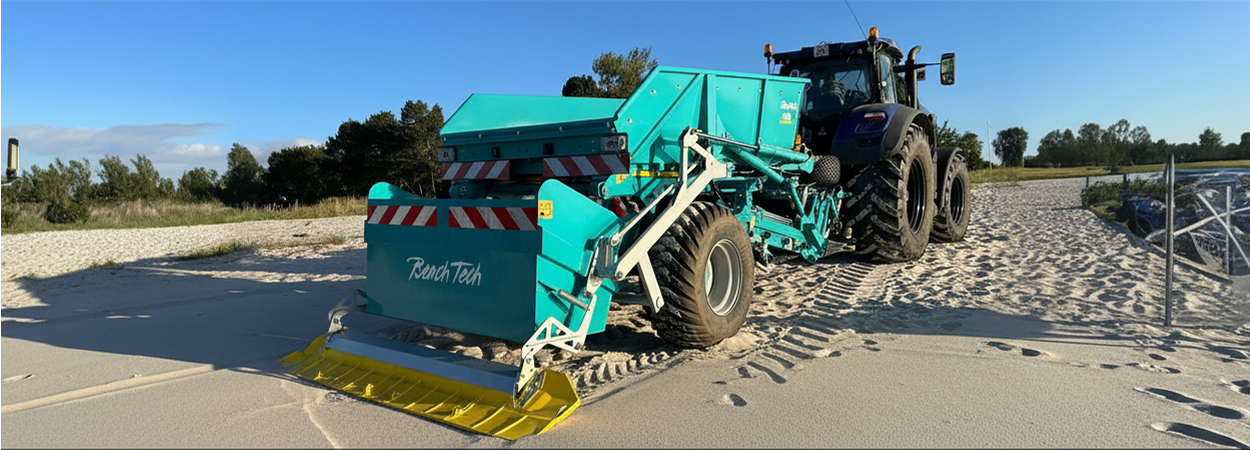
A Blue Flag is not won once. It has to be earned again every day, and machines do part of that work.
.png)
The Blue Flag is an international eco-label for beaches that meet 33 criteria covering water quality, environmental management, safety and education. Machinery cannot win a Blue Flag on its own, but daily mechanised sand cleaning helps a beach meet the environmental-management criteria year-round, which is where many beaches slip.
The Blue Flag is a voluntary eco-label awarded to beaches, marinas and sustainable boating operators by the Foundation for Environmental Education. A beach must meet 33 criteria, grouped into four areas: environmental education and information, water quality, environmental management, and safety and services.
Certification is not permanent. Beaches are monitored and can lose the flag if standards slip. Rushikonda Beach in Visakhapatnam earned its Blue Flag in 2020. In February 2025 the flag was temporarily withdrawn after concerns about maintenance and safety, and it was reinstated on 24 March 2025. The episode shows how much of the work is day-to-day upkeep.
Manual cleaning is valuable but struggles with consistency and depth on long, sandy stretches. Mechanised beach cleaning helps in four ways:
Machines support the environmental-management part of the checklist. They do not treat sewage, test bathing water, staff lifeguard posts or maintain toilets and changing rooms. A beach that is spotless but fails on water quality or facilities will not hold a Blue Flag. Cleaning technology works as one part of a larger system.
Pamtec's beach-cleaning machines have also been tried at clean-up drives and Swachh Bharat events by senior leaders, including Union Environment Minister Bhupender Yadav and several Chief Ministers.
What is the Blue Flag certification?
It is an international eco-label awarded by the Foundation for Environmental Education to beaches that meet 33 criteria for environmental education, water quality, environmental management, and safety and services.
Can machinery alone win a Blue Flag?
No. Water quality, safety services and facilities are assessed separately. Machinery supports the cleanliness and waste-management criteria.
Which Indian beaches were the first to get a Blue Flag?
Eight beaches were certified in 2020: Shivrajpur, Ghoghla, Kasarkod, Padubidri, Kappad, Rushikonda, Golden Beach and Radhanagar.
Can a beach lose its Blue Flag?
Yes. Certification is monitored. Rushikonda's flag was temporarily withdrawn in February 2025 and reinstated in March 2025.



.png)

.png)